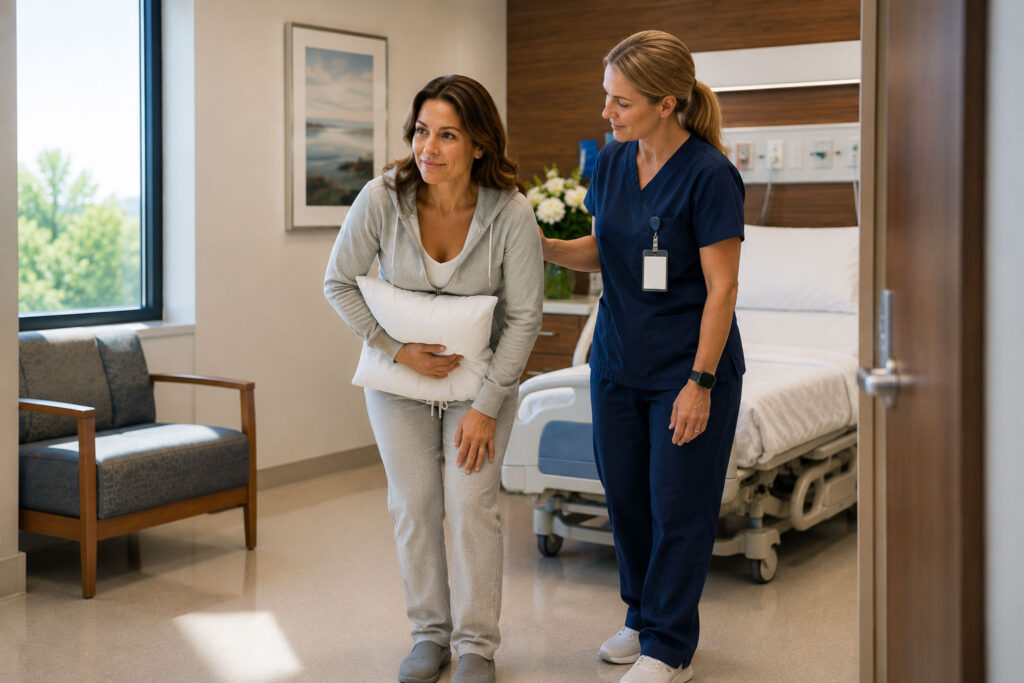
Breast implant reconstruction after mastectomy does not have to remain your permanent reconstructive choice.
Women who previously underwent breast reconstruction with implants can later choose to have those implants removed and reconstruct one or both breasts using their own natural tissue.
For appropriate candidates, breast implants can be removed and replaced directly with DIEP flaps, using living skin and fat from the lower abdomen while preserving the abdominal muscles.
This procedure, known as implant-to-DIEP flap conversion, allows patients to transition from implant-based reconstruction to a breast made from their own tissue.
Some women consider this option because they have developed implant-related problems, including capsular contracture, rippling, animation deformity, or discomfort. Others have implants that are functioning well but have decided that they no longer want permanent breast implants.
Another important group includes women with recalled Allergan BIOCELL textured implants who are exploring their reconstructive options and would prefer their own tissue rather than another set of implants.
The DIEP Group performs more than 300 DIEP flaps annually across our locations, including complex revision reconstruction and conversion from previous breast implants to natural tissue.
Our South Jersey program includes Dr. Alexander (Alex) Au, a plastic and reconstructive surgeon who previously practiced within the Virtua health system. Several surgeons within The DIEP Group also trained or practiced microsurgery at the University of Pennsylvania.
Patients throughout Marlton, Voorhees, Cherry Hill, Haddonfield, Moorestown, Mount Laurel, Medford, Mount Holly, and surrounding South Jersey communities can obtain consultations in Marlton, with DIEP flap surgery available at Virtua Voorhees Hospital and Virtua Mount Holly Hospital.
Can Breast Implants Be Replaced Directly with DIEP Flaps?
Yes. Women who previously underwent implant-based breast reconstruction after mastectomy may be candidates for direct conversion to DIEP flap reconstruction.
During surgery, the existing breast implants are removed and the breast pockets are prepared for the new reconstruction.
Skin and fat from the lower abdomen are transferred to the chest, where their blood vessels are connected using microsurgical techniques.
The transferred tissue is then shaped to create the reconstructed breast.
The resulting breast mound consists primarily of the patient’s own living tissue rather than a permanent implant.
Do I Need Tissue Expanders Between Implant Removal and DIEP Reconstruction?
Usually not.
For many appropriate candidates, the existing breast implants can be removed and DIEP flaps performed during the same operation.
There is generally no need to remove the implants, place tissue expanders, and then return for DIEP reconstruction as a separate routine sequence.
However, infection, implant exposure, severe tissue damage, or other complications may require a staged approach.
Why Do Women Choose to Replace Breast Implants with Their Own Tissue?
Not every woman considering implant-to-DIEP conversion has experienced a failed breast reconstruction.
Some patients initially chose implants because they offered a shorter operation, avoided an abdominal donor site, or were recommended as part of their original cancer treatment.
Years later, their priorities may change.
Reasons women consider replacing implants with DIEP flaps include:
- Wanting breast reconstruction made from their own tissue
- Preferring to eliminate permanent breast implants
- Wanting a softer, natural-feeling reconstruction
- Concerns about future implant-related procedures
- Previous radiation
- Capsular contracture or breast tightness
- Implant rippling or visible implant edges
- Animation deformity from subpectoral implants
- Implant malposition or asymmetry
- Implant rupture
- Previous implant infection or loss
- Concerns about recalled textured breast implants
The decision should be individualized. Implant reconstruction remains appropriate for many patients, while others ultimately prefer autologous reconstruction.
Can I Switch to DIEP Flaps Even if My Breast Implants Are Not Causing Problems?
Yes. A breast implant does not need to rupture, become infected, or develop capsular contracture before a patient can consider another reconstructive approach.
Some women have satisfactory implant reconstructions but decide that they no longer want permanent medical devices in their breasts.
Others learn about DIEP flap reconstruction only after completing implant-based reconstruction.
However, patients with uncomplicated implants should carefully weigh the potential benefits of natural-tissue reconstruction against the risks and recovery associated with another major operation.
Conversion is an option to consider, not an operation that every woman with implants needs.
Recalled Allergan BIOCELL Textured Breast Implants and DIEP Flap Reconstruction
In July 2019, Allergan voluntarily recalled its BIOCELL textured breast implants and tissue expanders after the FDA requested the recall because of their association with breast implant-associated anaplastic large cell lymphoma, or BIA-ALCL.
The recall has created an important reconstructive decision for some women who received textured implants after mastectomy.
Depending on their circumstances, patients may consider continued observation, implant removal with replacement by another implant, or implant removal followed by natural-tissue reconstruction.
For appropriate women who decide to remove their textured implants, DIEP flap reconstruction provides an alternative that does not require another permanent breast implant.
Does the FDA Recommend Removing Recalled Allergan Implants if I Have No Symptoms?
No.
The FDA does not recommend routine removal of Allergan BIOCELL textured implants in asymptomatic patients solely because of the recall.
Having a recalled implant does not automatically mean that it medically needs to be removed.
However, some women decide after informed discussion with their physicians that they would prefer not to continue with textured implant reconstruction.
For patients who elect implant removal, DIEP flap reconstruction may be considered as an alternative to implant replacement.
What Is BIA-ALCL?
Breast implant-associated anaplastic large cell lymphoma, or BIA-ALCL, is a type of lymphoma associated predominantly with textured-surface breast implants.
It is not breast cancer.
BIA-ALCL most commonly develops in the fluid or scar capsule surrounding the implant, although more advanced disease can involve surrounding tissues or lymph nodes.
Symptoms that warrant evaluation include persistent swelling around an implant, a new breast or chest wall mass, unexplained pain, or other concerning changes.
Patients with suspicious symptoms should undergo appropriate diagnostic evaluation before elective implant-to-DIEP conversion because a confirmed implant-associated malignancy may substantially change the surgical and treatment plan.
How Do I Know Whether My Allergan Breast Implants Were Recalled?
Patients may be able to identify their implants through:
- Breast implant identification cards
- Original operative reports
- Records from their previous plastic surgeon
- Hospital medical records
- Manufacturer and implant model information
The 2019 recall involved Allergan BIOCELL textured implants and tissue expanders. Allergan smooth implants were not included in that recall.
If the implant type is uncertain, obtaining the original operative records can help clarify which devices were placed.
What Happens During Implant-to-DIEP Flap Surgery?
Implant-to-DIEP conversion combines removal of the existing implant reconstruction with microsurgical transfer of the patient’s own abdominal tissue.
The operation generally involves:
- Removing the existing breast implants.
- Evaluating the implant pockets and surrounding scar capsules.
- Addressing the existing breast skin, capsule, and pectoralis muscle when necessary.
- Harvesting lower abdominal skin and fat while preserving the rectus abdominal muscles.
- Transferring the abdominal tissue to the chest.
- Connecting the flap blood vessels using microsurgical techniques.
- Shaping the transferred tissue to create the reconstructed breasts.
For bilateral reconstruction, abdominal tissue can be used to reconstruct both breasts during the same operation.
Does the Entire Breast Implant Capsule Have to Be Removed?
Not necessarily.
The appropriate management of the implant capsule depends on the reason for implant removal, capsule thickness, implant position, radiation history, symptoms, and other clinical factors.
Some patients benefit from partial or complete capsulectomy, while others do not require removal of every portion of an otherwise benign capsule.
The term en bloc capsulectomy has a specific oncologic meaning and should not be assumed necessary for every patient undergoing elective implant removal.
Patients with suspected or confirmed implant-associated malignancy require a different evaluation and surgical plan from asymptomatic patients choosing elective implant-to-DIEP conversion.
What Happens to the Pectoralis Muscle if My Implants Are Under the Muscle?
Many women who underwent implant reconstruction in previous years have subpectoral implants, meaning the implants were placed beneath the pectoralis major muscle.
This can contribute to animation deformity, in which contraction of the chest muscle causes visible movement or distortion of the reconstructed breast.
During implant-to-DIEP conversion, the subpectoral implant is removed.
The pectoralis major muscle is then returned to its normal anatomic position on the chest wall.
The DIEP flap then provides breast volume on top of the pectoralis muscle.
This can address animation deformity while converting the reconstruction to living tissue.
Can DIEP Flap Conversion Help After Radiation or Multiple Implant Revisions?
Women who have undergone radiation or repeated implant reconstruction procedures may face additional challenges.
Radiation can cause fibrosis, skin tightening, reduced elasticity, and impaired wound healing. Multiple previous operations can also create scar tissue, altered implant pockets, and thin mastectomy skin.
For selected patients, DIEP flap reconstruction can introduce healthy, vascularized tissue into the reconstructed breast while eliminating the need for permanent implants.
Can I Convert to DIEP Flaps Years After My Original Implant Reconstruction?
Yes. There is no requirement that implant-to-DIEP conversion occur shortly after mastectomy.
Patients may consider natural-tissue reconstruction many years after their original breast cancer treatment.
A woman may have been satisfied with her implants for years and later develop complications or simply change her reconstructive preferences.
The decision should be based on the patient’s current anatomy, medical history, available abdominal tissue, and goals rather than the age of the original reconstruction.
Can I Choose Smaller Breasts When Replacing Implants with DIEP Flaps?
Yes. DIEP flap reconstruction does not necessarily have to reproduce the volume of the existing implants.
Some women intentionally choose smaller breasts when transitioning to natural-tissue reconstruction.
However, the achievable breast size depends on the available abdominal tissue, existing breast skin, previous surgery, and desired shape.
Patients with large implants and limited abdominal tissue may not be able to reproduce their current breast volume using DIEP flaps alone.
Realistic expectations about breast size and contour should be established before surgery.
Implant-to-DIEP Flap Surgery at Virtua Hospitals in South Jersey
Women who previously underwent implant-based breast reconstruction can explore conversion to natural-tissue reconstruction through The DIEP Group’s South Jersey program.
DIEP flap surgery is available at Virtua Voorhees Hospital and Virtua Mount Holly Hospital, formerly known as Virtua Memorial Hospital.
Patients do not need to have undergone their original mastectomy or implant reconstruction at Virtua. Women who received previous care at Penn Medicine, another New Jersey hospital, or elsewhere may also be evaluated for implant-to-DIEP conversion.
Implant-to-DIEP Reconstruction at Virtua Voorhees Hospital
Virtua Voorhees Hospital provides a surgical location for women from Voorhees, Marlton, Cherry Hill, Haddonfield, Gibbsboro, Berlin, and surrounding Camden County communities.
Patients may be considering implant removal because of capsular contracture, recalled textured implants, previous radiation, or a preference to avoid permanent breast implants.
For appropriate candidates, the existing implants can be removed and DIEP flap reconstruction performed during the same operation.
Implant-to-DIEP Reconstruction at Virtua Mount Holly Hospital
Virtua Mount Holly Hospital serves women throughout Burlington County, including Mount Holly, Mount Laurel, Moorestown, Medford, Lumberton, Hainesport, Westampton, Burlington, and Cinnaminson.
Patients with previous implant reconstruction can meet with The DIEP Group in Marlton to discuss whether their abdominal tissue is suitable for conversion to DIEP flaps.
The appropriate surgical location depends on the patient’s medical circumstances, reconstructive plan, and insurance arrangements.
Experienced Microsurgeons for Implant-to-DIEP Reconstruction in South Jersey
Converting an existing implant reconstruction to DIEP flaps requires specialized planning because the surgeon is working with breast tissues that have already undergone mastectomy and one or more reconstructive procedures.
The existing implant pockets, scar capsules, mastectomy skin, pectoralis muscle, and any radiation-related changes must be evaluated before reconstruction.
The DIEP Group performs more than 300 DIEP flaps annually across its locations, with two surgeons participating in each DIEP flap procedure.
Several surgeons within The DIEP Group previously trained or practiced microsurgery at the University of Pennsylvania, bringing experience from a major academic reconstructive surgery environment.
The South Jersey team also includes Dr. Alexander (Alex) Au, a plastic and reconstructive surgeon who previously practiced within the Virtua health system and was associated with Penn Medicine’s regional breast reconstruction services.
His familiarity with South Jersey breast reconstruction provides an additional connection for patients who received their original cancer treatment or implant reconstruction through Virtua.
The DIEP Group is an independent surgical practice and is not affiliated with Penn Medicine.
For women considering implant-to-DIEP conversion, the relevant experience includes not only performing microsurgical tissue transfer but also managing the anatomy created by previous implant reconstruction.
Implant-to-DIEP Flap Consultations Throughout South Jersey
The DIEP Group provides consultations in Marlton for women throughout Burlington, Camden, and Gloucester counties who are considering replacing their breast implants with natural tissue.
Patients from Marlton, Voorhees, Cherry Hill, Haddonfield, Moorestown, Mount Laurel, Medford, Medford Lakes, and Mount Holly can seek evaluation regardless of where their original implant reconstruction was performed.
The program also serves women from Burlington, Cinnaminson, Lumberton, Hainesport, Westampton, Washington Township, Sewell, and surrounding communities.
For patients who previously underwent reconstruction at Virtua or another regional hospital, the consultation can help determine whether their existing implants can be removed and replaced directly with DIEP flaps.
Women with recalled textured implants may also seek evaluation to discuss their reconstructive options after reviewing the FDA’s recommendations regarding implant removal.
Why Choose The DIEP Group When You Already Have Breast Implants?
Implant-to-DIEP conversion is different from performing breast reconstruction for the first time.
The reconstructive surgeon must account for the anatomy created by previous operations, including established implant pockets, scar capsules, thin mastectomy skin, altered pectoralis muscle position, and possible radiation damage.
The DIEP Group focuses extensively on microsurgical breast reconstruction, including complex revision cases and conversion from previous implant reconstruction to natural tissue.
Our surgeons evaluate whether the existing breast skin can be preserved, how the implant pockets should be managed, and whether abdominal tissue can provide the desired breast size and shape.
For patients with subpectoral implants, the reconstructive plan may also include returning the pectoralis muscle toward its normal position.
For women with previous radiation, healthy vascularized tissue from the abdomen may help address some of the limitations of implant-based reconstruction in radiated tissues.
The goal is not simply to remove an implant. It is to determine whether a durable, natural-tissue reconstruction can provide an appropriate alternative based on the patient’s anatomy, previous treatment, and long-term preferences.
Frequently Asked Questions Before Replacing Breast Implants with DIEP Flaps
Will I Be Without Breasts Between Implant Removal and DIEP Reconstruction?
Usually not when direct implant-to-DIEP conversion is appropriate.
The existing implants can often be removed and the DIEP flaps transferred during the same operation.
A staged approach may occasionally be necessary because of infection, implant exposure, tissue damage, suspected implant-associated malignancy, or other individual circumstances.
Can My Existing Implant Scars Be Reused During DIEP Reconstruction?
Often, yes.
Previous mastectomy or reconstruction incisions can frequently be incorporated into the DIEP flap operation.
However, the surgical approach depends on scar location, skin quality, previous radiation, and the amount of tissue required for reconstruction.
Some patients may need additional incisions or replacement of damaged breast skin with skin from the abdominal flap.
What if My Implants Are Larger Than the Amount of Abdominal Tissue I Have?
The amount of available abdominal tissue places a practical limit on the volume of a DIEP flap reconstruction.
Women with large implants and relatively little abdominal tissue may not be able to reproduce the same breast size using the abdomen alone.
Some patients choose a smaller reconstruction, while others may need later fat grafting at a revision surgery.
A consultation can help establish realistic expectations regarding achievable breast volume and shape.
Can I Have DIEP Flap Reconstruction After Several Previous Implant Revisions?
Potentially, yes.
Multiple previous operations can make reconstruction more complex because of scar tissue, altered breast pockets, thin mastectomy skin, or previous complications.
However, these factors do not automatically eliminate DIEP flap reconstruction as an option.
The microsurgical team reviews previous operative reports, current anatomy, radiation history, and available recipient blood vessels before recommending a reconstructive approach.
What Records Should I Bring if I Am Concerned About Recalled Breast Implants?
If available, patients should bring their breast implant identification cards and previous operative reports.
Useful information includes the implant manufacturer, model, surface type, size, serial number, and date of implantation.
Records from the original plastic surgeon or hospital may help identify whether the implants were included in the Allergan BIOCELL recall.
Does Removing Recalled Allergan Implants Eliminate the Risk of BIA-ALCL?
Implant removal eliminates continued exposure to the removed device, but it should not be presented as a guarantee that BIA-ALCL can never develop.
The FDA does not recommend routine removal of recalled textured implants in asymptomatic patients solely because of the recall.
Women with persistent swelling, a breast or chest wall mass, unexplained pain, or other concerning symptoms should undergo appropriate evaluation before elective reconstruction.
Can My Breasts Be Revised Later After Implant-to-DIEP Conversion?
Yes.
Although the DIEP flaps become the definitive breast reconstruction, some patients benefit from additional procedures to refine breast shape or symmetry.
These may include fat grafting, contour adjustments, scar revision, nipple reconstruction, or other reconstructive refinements.
DIEP flaps do not have a routine replacement schedule, but this does not mean that additional surgery will never be necessary.
Does Commercial Insurance Cover Implant-to-DIEP Flap Reconstruction?
Implant-to-DIEP conversion after mastectomy may qualify for breast reconstruction coverage under applicable commercial insurance plans.
The Women’s Health and Cancer Rights Act provides coverage protections for breast reconstruction under many plans that include mastectomy benefits.
However, coverage depends on the patient’s specific insurance benefits, medical circumstances, authorization requirements, and network provisions.
The DIEP Group works with commercial insurance plans as an out-of-network provider and evaluates applicable benefits and authorization options.
The DIEP Group does not participate with Medicare, Medicaid, or TRICARE.
Explore Our South Jersey DIEP Flap Reconstruction Articles
Women considering implant-to-DIEP conversion may find the following articles helpful:
- DIEP Flap Breast Reconstruction in South Jersey: Complete Guide
- Natural Breast Reconstruction Without Implants in South Jersey
- Finding the Best DIEP Flap Surgeon in South Jersey
- DIEP Flap Breast Reconstruction After Radiation in South Jersey
- Replacing Breast Implants and Recalled Textured Implants with DIEP Flaps in South Jersey
- DIEP Flap After Failed or Complicated Implant Reconstruction in South Jersey
- Delayed DIEP Flap Reconstruction Years After Mastectomy in South Jersey
- DIEP Flap Breast Reconstruction After Mastectomy or Cancer Treatment at Virtua
- DIEP Flap Breast Reconstruction After Mastectomy or Cancer Treatment at Cooper
These articles provide additional information about natural-tissue reconstruction, previous radiation, implant complications, delayed reconstruction, and choosing an experienced DIEP flap surgeon in South Jersey.
Considering Removing Your Breast Implants? Find Out What Can Replace Them
If you are considering removing breast implants after mastectomy, an important question is what type of reconstruction you want after the implants are gone.
For appropriate patients, another set of implants is not the only option.
The DIEP Group can evaluate whether your existing implant reconstruction can be converted directly to natural-tissue reconstruction using skin and fat from your lower abdomen.
This consultation may be particularly useful for women with recalled textured implants, previous radiation, subpectoral implants with animation deformity, or a preference to move away from permanent breast implants.
Patients can continue receiving breast cancer surveillance and other medical care through their established physicians while The DIEP Group provides their reconstructive surgery.
The DIEP Group — South Jersey Office
MedCoShare Marlton
5 Greentree Center, Suite 117
Marlton, NJ 08053
Surgical Locations
Virtua Voorhees Hospital
100 Bowman Drive
Voorhees, NJ 08043
Virtua Mount Holly Hospital — Formerly Virtua Memorial Hospital
175 Madison Avenue
Mount Holly, NJ 08060
Phone: 203-200-0828
Website: thediepgroup.com
For women who no longer want permanent breast implants, a consultation can help determine whether their own abdominal tissue provides an appropriate alternative.
Medically Reviewed By
The Surgeons of The DIEP Group
The DIEP Group specializes in advanced microsurgical breast reconstruction, including implant-to-DIEP conversion, reconstruction after radiation, complex revision breast reconstruction, and reconstruction following previous implant complications.
The group performs more than 300 DIEP flaps annually across its locations.
References
1. U.S. Food and Drug Administration. FDA Requests Allergan Voluntarily Recall Natrelle BIOCELL Textured Breast Implants and Tissue Expanders.
2. U.S. Food and Drug Administration. Questions and Answers About Breast Implant-Associated Anaplastic Large Cell Lymphoma (BIA-ALCL).
3. U.S. Food and Drug Administration. Risks and Complications of Breast Implants.
https://www.fda.gov/medical-devices/breast-implants/risks-and-complications-breast-implants
4. American Society of Plastic Surgeons. Breast Implant-Associated Anaplastic Large Cell Lymphoma (BIA-ALCL).
https://www.plasticsurgery.org/patient-safety/breast-implant-safety/bia-alcl-summary
5. American Society of Plastic Surgeons. Breast Reconstruction Using Flap Surgery.
https://www.plasticsurgery.org/reconstructive-procedures/breast-reconstruction/flap-surgery
6. National Cancer Institute. Breast Reconstruction After Mastectomy.
https://www.cancer.gov/types/breast/reconstruction-fact-sheet
7. American Cancer Society. Breast Reconstruction Options.
https://www.cancer.org/cancer/types/breast-cancer/reconstruction-surgery.html
8. U.S. Department of Labor. Women’s Health and Cancer Rights Act (WHCRA).
https://www.dol.gov/agencies/ebsa/laws-and-regulations/laws/whcra
9. Virtua Health. Virtua Voorhees Hospital.
https://www.virtua.org/locations/hospital/virtua-voorhees-hospital
10. Virtua Health. Virtua Mount Holly Hospital.
https://www.virtua.org/locations/hospital/virtua-mount-holly-hospital
Medical Disclaimer This article is for educational purposes only and does not constitute individualized medical advice. Decisions regarding breast implant removal and reconstruction should be individualized based on implant type, symptoms, cancer history, previous surgery, radiation, anatomy, available donor tissue, medical history, and patient preferences.